
Pentagon Warns of 6-Month Timeline to Clear Iranian Naval Mines in Strait of Hormuz
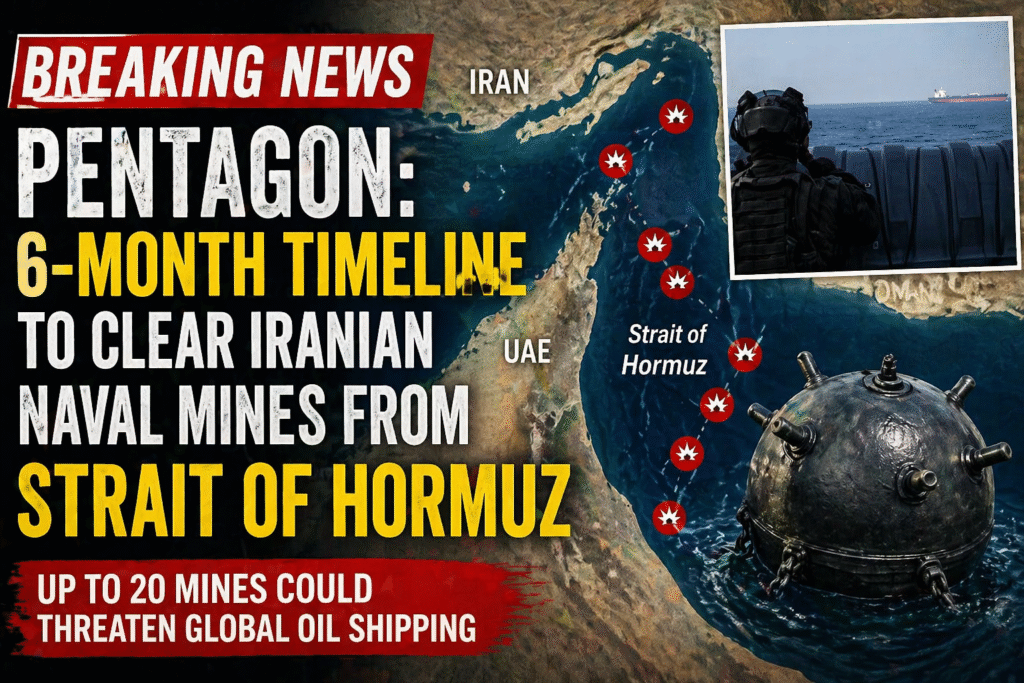
Pentagon Briefing Raises Global Security Concerns
Strait of Hormuz mines — this emerging situation has sparked serious geopolitical and economic concerns worldwide. According to reports, the Pentagon has informed lawmakers that removing naval mines allegedly deployed by Iran could take up to six months. The briefing was delivered to the House Armed Services Committee, highlighting the complexity and risks involved in clearing such threats.
The information, first reported by The Washington Post, suggests that the mine-clearing operation may not begin immediately and could be delayed until after any potential conflict between the United States and Iran concludes.
Importance of the Strait of Hormuz
A Critical Global Oil Route
The Strait of Hormuz is one of the most strategically important waterways in the world. Roughly 20% of global oil supply passes through this narrow corridor, making it a vital artery for international trade and energy security.
Any disruption in this region can have immediate effects on global oil prices, shipping routes, and economic stability. Even the presence of a small number of naval mines—estimated to be around 20—can significantly hinder maritime traffic due to safety risks.
Challenges in Mine Clearance Operations
Why It Could Take Six Months
Clearing naval mines is a highly specialized and dangerous operation. Unlike conventional warfare, mine countermeasure missions require precision, advanced technology, and extensive coordination. The Pentagon emphasized that even a limited number of mines can take months to neutralize due to several factors:
- Detection Difficulty: Naval mines are often designed to evade sonar detection and can be hidden in complex underwater terrain.
- Safety Protocols: Each mine must be carefully identified and neutralized to avoid accidental detonation.
- Limited Resources: Mine-clearing ships and equipment are limited and must be deployed strategically.
- Hostile Environment: Operations may be delayed if active conflict persists in the region.
Military and Strategic Implications
Delayed Operations Until Conflict Ends
One of the most concerning aspects of the briefing is that mine-clearing efforts are unlikely to begin until after any direct military conflict concludes. This means that if tensions escalate into war, the Strait of Hormuz could remain partially blocked for an extended period.
Such a delay could:
- Disrupt global oil supply chains
- Increase insurance costs for shipping companies
- Force rerouting of vessels, leading to higher transportation costs
- Trigger volatility in global financial markets
Economic Impact on Global Markets
Oil Prices and Trade Disruptions
The presence of naval mines in such a crucial shipping lane could push oil prices higher due to uncertainty and reduced supply. Countries heavily dependent on oil imports, including India, China, and European nations, could face economic pressure.
Additionally, global shipping companies may hesitate to pass through the region without assurance of safety, leading to delays and increased operational costs.
Geopolitical Tensions and Future Outlook
Rising Tensions Between the U.S. and Iran
The situation underscores ongoing tensions between the United States and Iran. While no official confirmation has been made regarding active mine deployment, the possibility alone has raised alarms in defense and diplomatic circles.
The House Armed Services Committee continues to monitor developments closely, and further briefings are expected as the situation evolves.
Conclusion
The warning from the Pentagon about a potential six-month timeline to clear naval mines from the Strait of Hormuz highlights the seriousness of the situation. Even a relatively small number of mines can create massive disruptions in global trade and energy supply.
As reported by The Washington Post, the delay in initiating clearance operations adds another layer of complexity, especially if geopolitical tensions escalate further. The coming weeks will be critical in determining whether diplomatic efforts can prevent escalation or if the world must prepare for economic and strategic consequences.
read more:https://viralvista91.com/mumbai-woman-confronts-minister-rally-traffic-jam-debate/