
AAP MPs Join BJP 2026: Major Political Shift in Rajya Sabha
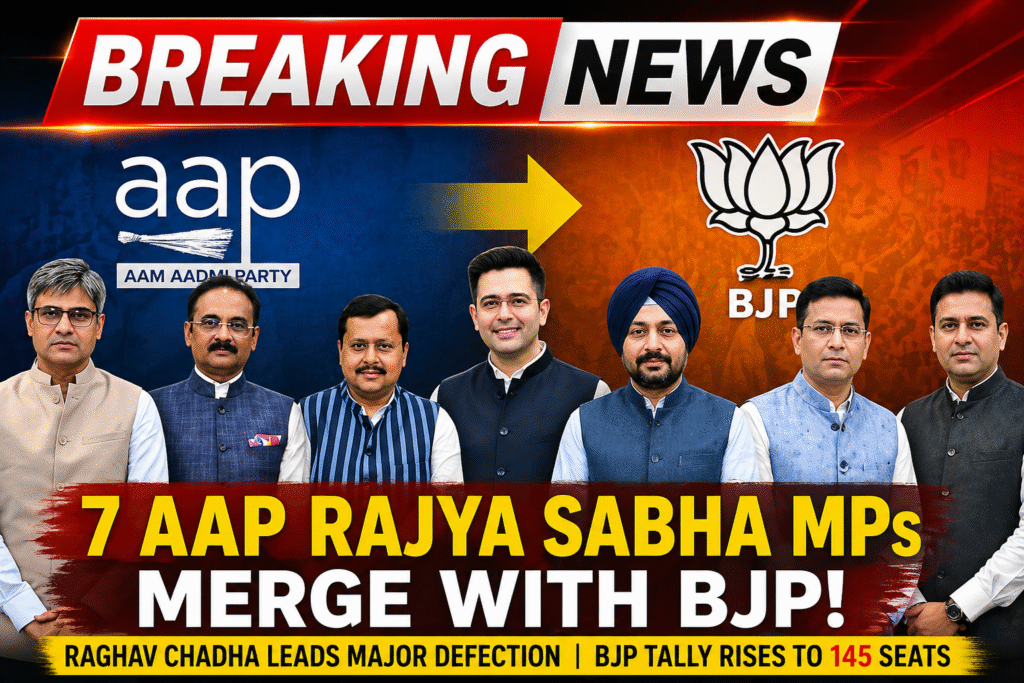
AAP MPs Join BJP 2026 :In a dramatic political development, seven Members of Parliament (MPs) from the Aam Aadmi Party (AAP) have merged with the Bharatiya Janata Party (BJP) in the Rajya Sabha. This move, which took place on April 24, 2026, marks one of the most significant defections in recent parliamentary history and could reshape the balance of power in India’s upper house.
The defection was led by prominent AAP leaders including Raghav Chadha, Sandeep Pathak, and Ashok Mittal. Along with them, other notable MPs such as Harbhajan Singh and Swati Maliwal also joined the new faction aligned with the BJP.
How the Defection Happened
The group of seven MPs used the provisions of the Tenth Schedule of the Indian Constitution, which allows a merger if at least two-thirds of a party’s legislators agree to it. By meeting this threshold, the MPs avoided disqualification under India’s anti-defection laws.
The formal documentation of the merger was submitted to the Rajya Sabha Chairman, Jagdeep Dhankhar. After verification, the merger was acknowledged, making it legally valid.
This strategic move ensured that the defecting MPs retained their positions without facing penalties, a key factor that made the transition smoother and politically impactful.
Impact on AAP and BJP
AAP’s Position Weakens
Following this development, AAP’s strength in the Rajya Sabha has been drastically reduced from 10 MPs to just three. The remaining members include Sanjay Singh, ND Gupta, and Balbir Singh Seechewal.
This sudden reduction significantly weakens AAP’s voice in the upper house and raises questions about internal party unity and leadership direction.
BJP Gains Strength
On the other hand, the BJP has benefited greatly from this merger. With the addition of seven MPs, the party’s tally in the Rajya Sabha has reportedly risen to 145 seats. This increase strengthens BJP’s legislative power and could make it easier to pass key bills without heavy reliance on allies.
Reasons Behind the Defection
Leadership and Ideological Differences
Raghav Chadha openly criticized AAP’s leadership, stating that the party had deviated from its original anti-corruption agenda. According to him, the core values that once defined AAP were no longer being upheld.
This sentiment appears to have resonated with other defecting MPs, who may have felt disconnected from the party’s evolving political strategy.
Allegations and Counter-Allegations
AAP, however, strongly condemned the move. Party leaders labeled Chadha a “traitor” and accused the BJP of engaging in political “poaching” to weaken opposition parties.
The BJP has not officially responded to these allegations but has welcomed the new members, emphasizing unity and development-focused governance.
Political Reactions Across India
The defection has triggered widespread reactions across the political spectrum:
- Opposition parties have expressed concern over the increasing dominance of the BJP.
- Political analysts see this as a strategic victory for the ruling party ahead of future elections.
- Supporters of AAP are divided, with some criticizing the defectors while others questioning party leadership.
This event has also reignited debates about the effectiveness and ethical implications of India’s anti-defection laws.
What This Means for Indian Politics
Short-Term Effects
In the immediate future, BJP’s strengthened position in the Rajya Sabha could accelerate legislative processes. Bills that previously faced resistance may now pass more smoothly.
Long-Term Implications
In the long run, this defection could:
- Influence voter perception of AAP’s stability
- Encourage similar moves in other parties
- Shift alliances ahead of upcoming elections
It also raises important questions about political loyalty, ideology, and the role of legal provisions in enabling such large-scale defections.
Conclusion
The merger of seven AAP MPs with the BJP is more than just a political shift—it is a turning point in India’s parliamentary dynamics. While BJP emerges stronger, AAP faces a critical moment of introspection and rebuilding.
As the political landscape continues to evolve, this event will likely remain a key reference point in discussions about party loyalty, governance, and democratic integrity in India.
read more:https://viralvista91.com/strait-of-hormuz-mines/