
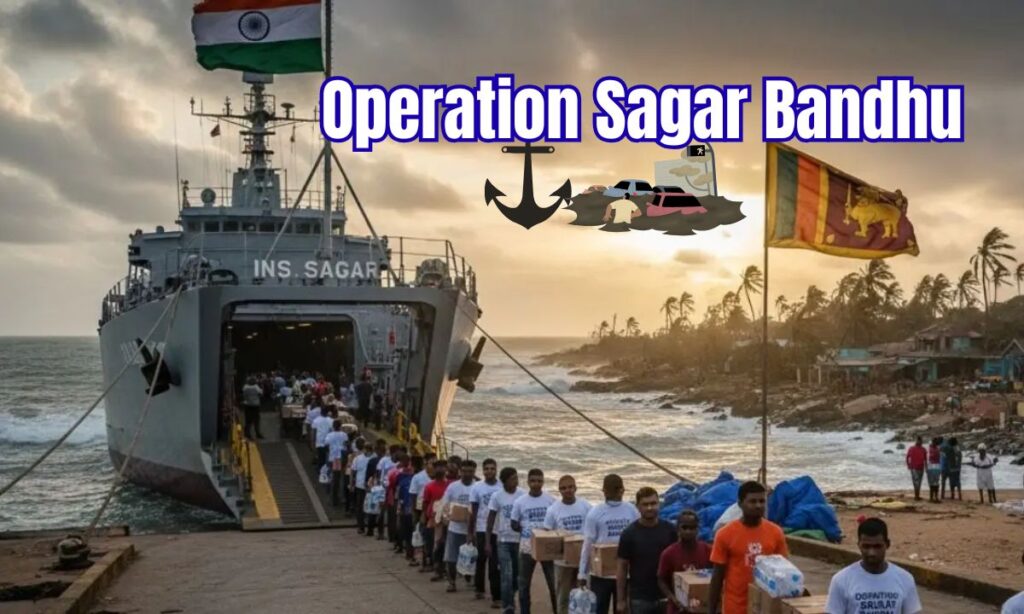
Operation Sagar Bandhu: India Steps Up to Rebuild Sri Lanka After Cyclone Devastation
When Cyclone Ditwah ripped through Sri Lanka in late November 2025, it unleashed one of the most destructive natural calamities the island had faced in years. Torrential rains, landslides, and overflowing rivers cut off major roads, isolated villages, and crippled essential services. At a moment when Sri Lanka was struggling to restore basic access to affected districts, India launched Operation Sagar Bandhu, a comprehensive humanitarian mission aimed at rebuilding connectivity and supporting local authorities in rescue and relief.
From emergency food aid to high-capacity engineering support, the operation has now evolved into one of India’s most coordinated overseas disaster-response missions in recent times.
Rapid Mobilisation: India as the First Responder
Within hours of receiving distress signals from Colombo, India activated its armed forces for a multi-layered relief operation. Transport aircraft, naval vessels, medical teams, and rescue specialists were put on standby — reflecting India’s growing readiness for regional humanitarian crises.
The Indian Air Force played a pivotal role in the initial phase. Special transport aircraft were deployed to fly in humanitarian supplies: tents, medicines, dry rations, water purification units, and essential rescue gear. Teams of National Disaster Response Force (NDRF) personnel arrived equipped with inflatable boats, electrical saws, and medical kits, enabling door-to-door rescue in badly affected regions.
Simultaneously, the Indian Navy diverted frontline warships that were already docked in Colombo for a scheduled event. These ships quickly transitioned from ceremonial duties to relief missions, carrying tonnes of food supplies and freshwater for stranded communities.
This rapid response demonstrated why India is increasingly seen as the “first responder” in the Indian Ocean region — capable of combining speed, scale, and strategic intent during a humanitarian emergency.

Restoring Connectivity: The Bridge-Building Mission
One of the biggest setbacks for Sri Lanka after the cyclone was the collapse of road networks caused by landslides and strong water currents. Many rural and semi-urban pockets became inaccessible, blocking not only relief movement but also daily essentials for thousands of families.
To address this, India has now shifted Operation Sagar Bandhu into a reconstruction phase.
A special IAF aircraft recently airlifted Bailey bridge components, along with engineering teams trained to assemble modular bridges in crisis zones. These portable steel bridges are crucial for creating temporary but strong road connections in places where existing structures have been washed away.
By deploying these bridge units:
- Relief material can now reach isolated regions faster
- Medical teams can access areas previously cut off
- Essential transport routes are reopening for local communities
- Sri Lanka can begin phased rebuilding without waiting for long-term infrastructure replacement
This form of engineering support goes beyond emergency assistance — it helps restore mobility, economy, and normalcy.
Humanitarian Aid: From Food to Medical Support
India’s relief material has been wide-ranging to address the different types of distress caused by the cyclone. Packages have included:
- Dry rations and ready-to-eat meals
- Fresh vegetables and drinking water
- Blankets, bedding, and hygiene kits
- First-aid supplies and essential medicines
- Water purification devices for flood-hit areas
Special medical teams were also deployed alongside the aid consignments to assist in treating injuries, infections, and waterborne diseases that often surge after large floods.
This comprehensive mix of aid ensures that the intervention is not symbolic, but genuinely effective in reducing the suffering of affected families.
India–Sri Lanka Partnership Strengthened : Operation Sagar Bandhu
Operation Sagar Bandhu is more than a relief exercise — it is a reflection of India’s long-standing commitment to supporting its neighbours during moments of crisis. Over the past decade, India has participated in several similar missions across the Indian Ocean, but the support offered to Sri Lanka this time stands out for its speed and scale.
For Sri Lanka, still recovering from recent economic turmoil and infrastructure challenges, India’s timely assistance carries both practical and emotional value. It builds trust and goodwill between the two nations and reinforces the idea that regional cooperation in South Asia is crucial in the era of climate-driven disasters.
A Model for Future Disaster Response
The cyclone has also highlighted the increasing vulnerability of the region to extreme weather events. As such calamities become more frequent, Operation Sagar Bandhu offers a blueprint for future relief missions — involving:
- Quick mobilisation of assets
- Integrated response by air, sea, and land units
- Deployment of ready-to-use engineering solutions
- Coordination with local agencies
- Sustained, multi-phase assistance instead of one-time aid
This approach ensures that relief is not just immediate, but also meaningful in the long run.
Read this also : Putin India Visit 2025_ Historic Summit on December 4–5
Conclusion : Operation Sagar Bandhu
Operation Sagar Bandhu stands as a powerful example of how humanitarian action, timely decision-making, and regional solidarity can together make a real difference in the aftermath of a natural disaster. As Sri Lanka begins its long path to recovery, India’s support — from food supplies to bridge construction — is playing a central role in helping communities regain stability.
The mission not only strengthens India–Sri Lanka ties but also reaffirms India’s position as a responsible and compassionate first responder in the Indian Ocean region.