
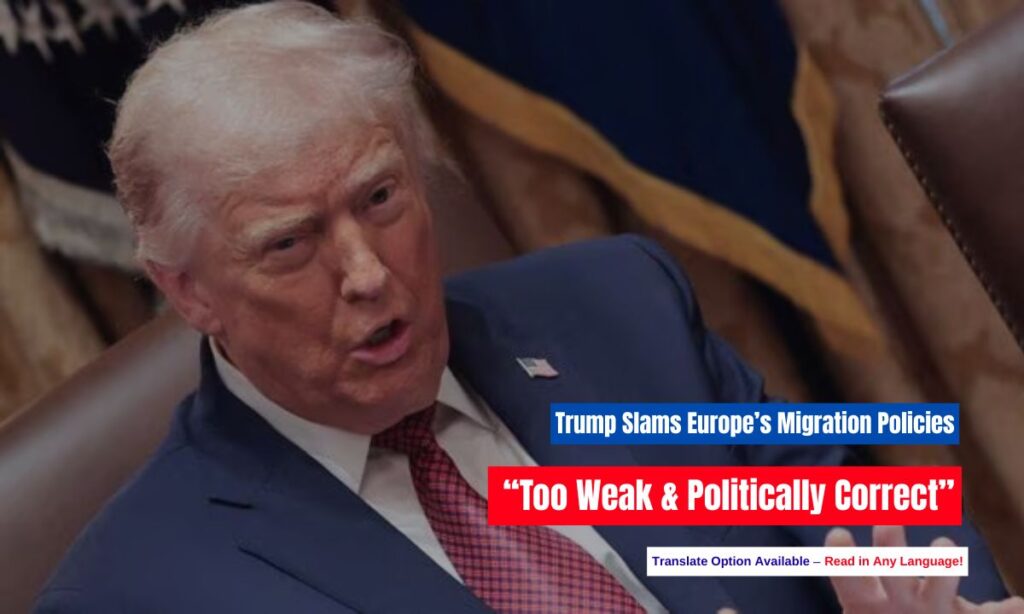
Donald Trump Slams Europe’s Migration Policies, Calls Them “Weak” and “Politically Correct”
Former US President Donald Trump has once again drawn global attention with his outspoken comments—this time targeting Europe’s migration policies, which he described as “much weaker” and “too politically correct” to handle modern security challenges. His latest remarks have ignited intense debate across political and diplomatic circles, particularly at a time when Europe is already facing growing concerns over border pressures, demographic shifts, and increasing geopolitical tensions.
Trump’s criticism reflects his long-standing stance on immigration: tight borders, stricter vetting, and strong national-security-driven policies. But his recent comments also highlight the widening gap between US conservative perspectives and European liberal migration models.
Trump Claims Europe Is Losing Control Over Migration
According to Trump, Europe’s migration system is “poorly structured and extremely vulnerable.” He argued that EU nations have allowed large-scale migration without proper security checks or integration mechanisms. In his words, Europe has become “too afraid to offend anyone,” leading to decisions he believes are weakening national identity, culture, and stability.
He emphasized that migration is not merely a humanitarian issue but a security challenge that requires firm action. Trump reiterated that nations must put their own citizens first and adopt policies that protect the borders with strong enforcement.
His statements resonate with conservative leaders in several European countries who have been pushing for tougher laws and revisiting long-standing refugee policies.

A Familiar Debate Revived on the Global Stage
Migration has always been a polarizing subject within Europe. Countries like Germany, Sweden, France, and Italy have taken different approaches—some welcoming refugees, others campaigning for strict limits. Trump’s comments have resurfaced old debates about responsibility, integration, and cultural identity.
Many analysts believe Trump’s intervention was intentional, aiming to:
- Influence global conservative movements
- Draw attention to Europe’s internal tensions
- Reinforce his own political message of border security
While European leaders did not immediately respond, political commentators suggest Trump’s remarks will fuel discussions within right-wing groups who share similar sentiments.
Europe at a Crossroads: Balancing Humanitarian Needs and Internal Security
The ongoing migration pressures—from conflict zones, climate migration, and economic instability—continue to test Europe’s resources. Trump’s remarks raise a critical question: Is Europe’s current policy model sustainable?
Experts point out several challenges:
1. Overburdened Asylum Systems
Many EU countries struggle with slow processing, insufficient infrastructure, and backlog issues.
2. Rising Public Concerns
Large sections of the European population feel uneasy about cultural changes, economic impacts, and social integration.
3. Political Polarization
Migration remains a key factor in the rise of right-wing political parties across Europe.
4. Security Considerations
Authorities continually warn that unmanaged migration flows can be exploited by extremist networks.
Trump highlighted these issues as evidence that Europe urgently needs a more robust, unified, and security-first approach.
Trump’s Warning: Europe Could “Lose Its Identity”
One of the most striking elements of Trump’s speech was his claim that Europe risks “losing its cultural foundation” if migration continues without stronger controls. He said that uncontrolled migration would permanently alter Europe’s social fabric and weaken its geopolitical influence.
Critics of Trump, however, argue that his remarks oversimplify a complex issue and often ignore Europe’s longstanding humanitarian commitments.
Still, Trump’s statements reflect concerns shared by several European policymakers who argue that integration must be measured and manageable, not chaotic.
Read this also : Trump airspace announcement
A Message with Global Implications
Trump’s position on European migration is not just commentary—it symbolizes a broader ideological divide in global politics. On one side are leaders who advocate for stronger borders and stricter rules; on the other are governments that prioritize humanitarian responsibility and multicultural inclusion.
His remarks could influence:
- The 2025–26 global political climate
- EU migration reform discussions
- US–Europe diplomatic relations
- International debates on border control
Migration is no longer a regional issue—it is a global challenge requiring cooperation, foresight, and balance.
Conclusion
The latest update surrounding Donald Trump’s criticism of Europe’s migration policies underscores a growing worldwide debate: how can nations protect borders while maintaining humanitarian values?
Whether one agrees with Trump or not, his comments force the world to rethink the future of migration, the importance of national security, and the need for strong, unified policies. Europe may have tough decisions ahead, and Trump’s words may intensify an already heated political conversation.