
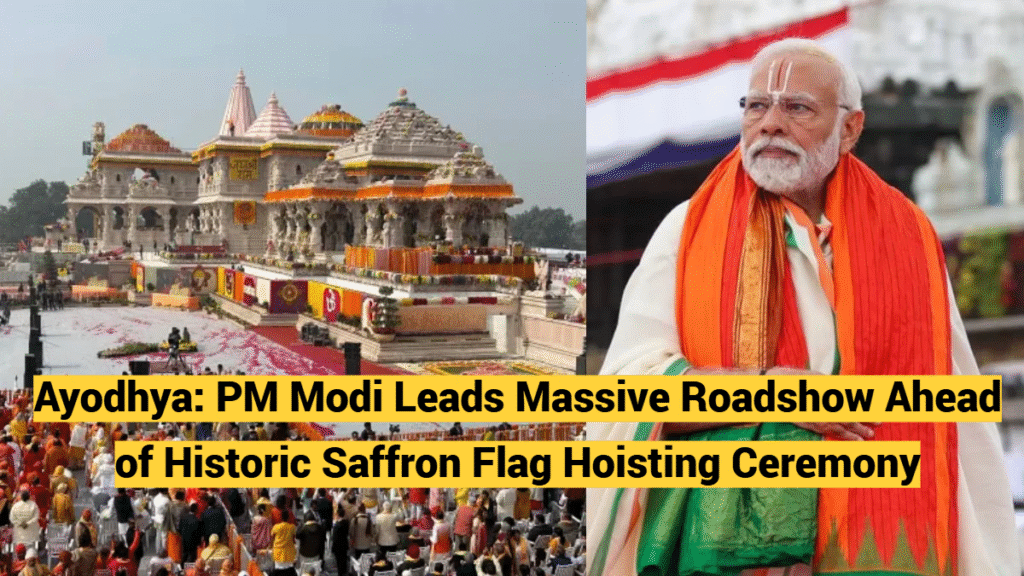
Ayodhya is bracing for one of the most historic and symbolically charged events in recent times. On 25 November 2025, Prime Minister Narendra Modi will lead a grand roadshow through the city, culminating in the hoisting of a saffron flag atop the main spire of the Ram Janmabhoomi Temple.
This event, known as Dhwajarohan, marks more than just a religious ritual. It is being portrayed as the formal completion of the temple project and a moment of deep national and cultural symbolism.
Grand Preparations and the Roadshow
The lead-up to the ceremony has turned Ayodhya into a beehive of activity. Roads are being cleaned and freshly painted, and floral decorations and lights brighten every corner of the city.
Posters of the Prime Minister are displayed throughout Ayodhya, creating a festive yet solemn atmosphere.
Security has been heightened with a multi-tier security grid involving thousands of personnel. Vehicular and pedestrian movement along key stretches, especially Ram Path, has been heavily restricted.
PM Modi’s roadshow is not just ceremonial. According to officials, he will visit several important temples inside the complex, including the Saptmandir, Sheshavatar Mandir, and Mata Annapurna Mandir.
After these visits, he will perform puja, have darshan at the Ram Lalla sanctum, and address assembled saints and dignitaries.
The Flag and Its Deep Symbolism
The heart of the Dhwajarohan is the saffron flag that PM Modi will hoist. This is not just a flag — it is rich with cultural and spiritual symbolism.
The triangular saffron banner, measuring around 22 ft by 11 ft, carries three sacred motifs:
- A radiant Sun, symbolizing Lord Ram’s Suryavanshi lineage
- The sacred syllable “Om”, representing cosmic vibration
- The Kovidara tree, symbolizing purity, growth, and the ideals of Ram Rajya
The flag is made from parachute-grade fabric reinforced with silk threads to withstand wind and weather. It will be mounted on a 42-foot rotating pole, allowing it to flutter freely atop the temple’s 161-foot spire.
The timing of the ceremony is also symbolic. It takes place on Vivah Panchami, the festival celebrating the divine wedding of Lord Ram and Goddess Sita.
Priests have selected the Abhijeet Muhurat — an auspicious window between 11:52 AM and 12:35 PM — for the hoisting.
Why This Event Matters
Religious Completion and Activation
For devotees, the Dhwajarohan marks the spiritual activation of the Ram Temple as a “fully sovereign divine abode.” While the Pran Pratishtha in 2024 brought the deity to life, this ceremony symbolizes the architectural and ritual completion of the temple.
Symbol of Ram Rajya
The saffron flag symbolizes the ideals of Ram Rajya — righteous governance, virtue, and social harmony. The symbols on the flag reflect lineage, purity, and spiritual strength.
Political Resonance
Inviting the Prime Minister adds a layer of political significance. This moment ties together years of narrative — from foundation laying to completion — and reinforces the sentiment of fulfilling a long-awaited cultural dream.
The presence of leaders like Mohan Bhagwat, Yogi Adityanath, and the Governor makes this event a powerful blend of political, cultural, and spiritual leadership.
Public Engagement and Broadcast
About 6,000 invited guests are expected. Due to space limitations, over 50 LED screens have been set up across Ayodhya to broadcast the ceremony live for the public.
Security and Logistics
Nearly 6,970 personnel from various units, including ATS, NSG, and cyber teams, are deployed.
Around 1,600 hotel rooms and multiple tent cities have been prepared for guests. Movement along Ram Path will be restricted until the ceremony concludes.
Broader Cultural and National Impact
This event is being framed as a major cultural milestone for India. The saffron flag is not just a religious symbol — it is positioned as a civilizational emblem combining devotion, heritage, and national pride.
For many, this moment reflects a vision of India where spirituality and modern governance coexist. It sends a message of cultural resurgence and unity.
Potential Critiques
Not everyone views the event the same way:
- Some critics believe the involvement of a political leader in a religious ritual blurs lines between religion and governance.
- Others see it as a political spectacle designed to strengthen ideological narratives.
- There are also concerns about accessibility for ordinary devotees who must rely on live broadcasts.
Conclusion
PM Modi’s roadshow in Ayodhya ahead of the Dhwajarohan ceremony represents the culmination of a decades-long journey. The saffron flag atop the Ram Temple’s spire is more than fabric — it symbolizes faith, unity, and the intersection of religion and national identity.
This historic moment is likely to remain etched in India’s cultural memory, marking not just the completion of a temple, but the unfolding of a new chapter in the nation’s spiritual and cultural narrative.
Read more: https://viralvista91.com/karimnagar-chess-players-qualify-for-nationals/


Pingback: Pakistan Air Force Strike on Afghanistan: Full Details, Casualties, Reactions & Rising Tensions — Latest Update - viralvista91.com
Pingback: Rohit Sharma Named Ambassador for 2026 T20 World Cup – A Proud Moment for India - viralvista91.com