
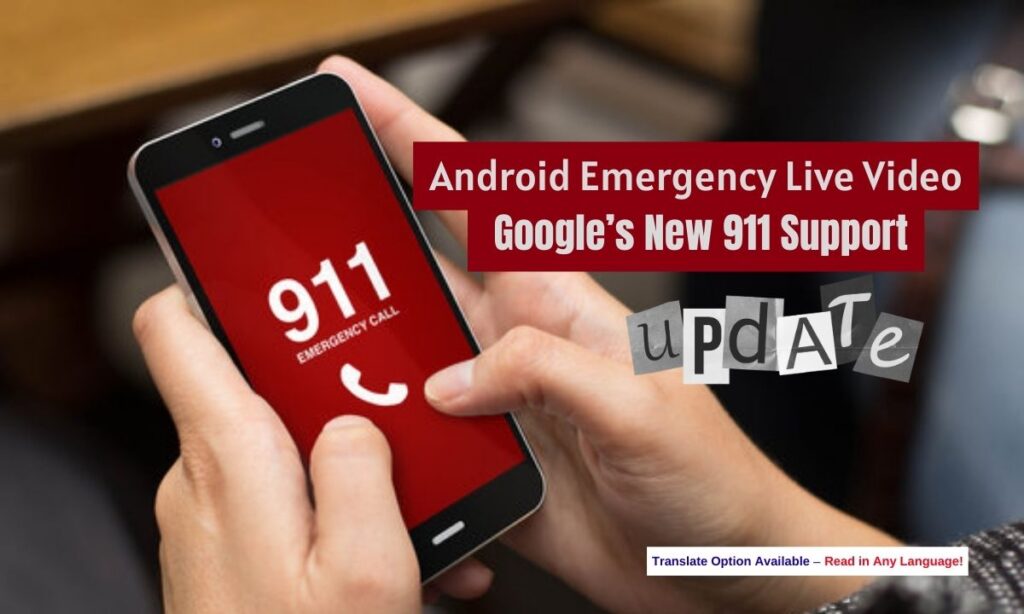
Android Emergency Live Video Feature: Google Introduces A Major Step Forward for 911 Support
Google has unveiled one of its most impactful safety upgrades for Android users — the Android Emergency Live Video feature, a tool that allows people to share real-time video directly with 911 dispatchers during a crisis. This new capability aims to bridge the information gap that often occurs when people struggle to explain an emergency through voice alone. With this rollout, Google is transforming the smartphone into a far more dynamic life-saving device.
For years, emergency services have relied primarily on voice calls and, more recently, text messages. But emergencies can escalate quickly, and verbal descriptions are not always enough to describe the severity of a situation. Google’s new feature adds an entirely new layer of clarity — visual evidence in real time, streamed securely and only with the caller’s permission.
A Simple Concept with Powerful Impact
The idea behind the Android Emergency Live Video feature is straightforward: when a user calls or messages 911, the dispatcher can request access to the phone’s camera feed. If the caller chooses to accept, a secure video stream begins instantly, giving responders a live, unfiltered look at what is unfolding.
This is particularly helpful in emergencies where:
- The caller is injured or unable to speak
- The environment is chaotic or loud
- A visual scene is more informative than words
- A child or bystander is calling on behalf of someone else
- The caller is panicked and struggling to describe the situation
By giving dispatchers “eyes on the scene,” the feature helps responders assess danger, determine urgency, and provide step-by-step guidance that fits the exact situation.
Full Control Remains with the User : Android Emergency Live Video feature
One of the strongest aspects of the Android Emergency Live Video feature is that sharing video is completely optional. The stream begins only if the caller taps “Allow” when prompted. This means users maintain full control of their privacy during stressful moments.
Google has also emphasized the following safeguards:
- Video is encrypted during transmission
- Only the emergency center can view the stream
- The caller can stop sharing at any time
- No video is recorded or saved by default
- Emergency audio continues even if video stops
This approach ensures that even though the technology is powerful, it does not compromise user autonomy or safety.
Why Real-Time Video Matters More Than Ever
Emergency professionals have long pushed for richer communication tools. When dispatchers can visually confirm an incident — whether it’s a car crash, medical emergency, fire, or suspicious activity — they gain a level of clarity that a phone call often cannot provide.
Real-time video can help dispatchers:
- Identify immediate threats
- Evaluate injury severity
- Give precise instructions (CPR, bleeding control, escape directions)
- Alert incoming responders about specific hazards
- Reduce response times by eliminating guesswork
Studies in emergency response show that visual context often leads to faster, more accurate decision-making, which can directly impact survival rates.
Compatibility and Availability
The feature is available on most Android phones running Android 8 or later, making it accessible to hundreds of millions of users. It works through Google Play services, so no additional app installation or manual update is needed.
However, the live video capability depends on whether local emergency centers support the system. Google is currently expanding the rollout across the U.S. and working with public safety technology partners to bring the feature to more regions globally.
Even as it gradually expands, the foundation is already in place — meaning users in supported areas will automatically have access as soon as their local emergency infrastructure enables it.
A Major Leap for Public Safety Technology
With this update, Google is positioning Android as a leader in mobile safety innovation. Emergency response has traditionally evolved slowly, but this feature pushes the system forward in a meaningful way.
This upgrade represents:
- A modernization of 911 communication
- A smarter use of smartphone capabilities
- A new safety standard for mobile operating systems
- A potential lifesaver during high-risk situations
Tech experts say this might pave the way for future enhancements, such as sharing real-time location tracking, biometric data, or environmental sensors during emergencies.
Read this also : Android Phone Storage Full? కారణాలు & బెస్ట్ క్లీనింగ్ ట్రిక్స్
Conclusion
The Android Emergency Live Video feature marks a major advancement in how people communicate with emergency services. It helps eliminate confusion, delivers critical visual information when it matters most, and gives dispatchers the ability to guide callers with unmatched clarity. As Google continues its roll-out across different regions, millions of Android users will gain access to a tool that could make a real difference when facing life-threatening situations.
This innovation doesn’t just change how we call for help — it changes how quickly help can reach us.