
India Successfully Tests Fighter Jet Ejection System at 800 km/h, marking a historic breakthrough in the country’s defence innovation journey. The Defence Research and Development Organisation (DRDO) successfully conducted a high-speed rocket-sled test to validate the emergency pilot escape mechanism at extreme conditions. This accomplishment places India among an elite group of technologically advanced defence nations capable of conducting high-speed dynamic ejection trials.
This major milestone significantly boosts the safety of fighter pilots and strengthens India’s indigenous defence manufacturing ecosystem. The test proves India’s ability to design and validate world-class aviation safety systems without foreign dependency.
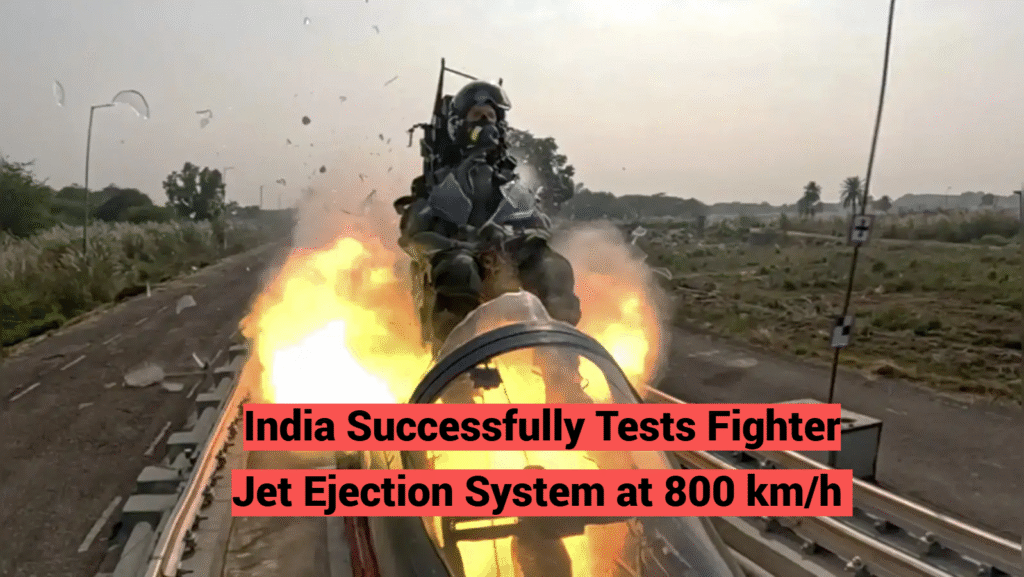
Why the India Successfully Tests Fighter Jet Ejection System at 800 km/h Is Critically Important
Ejection seats are among the most crucial safety technologies in fighter aircraft. When a pilot faces sudden engine failure, mid-air collision, or combat strike, the ability to eject instantly determines survival. Testing an ejection system at 800 km/h is extremely challenging because real emergency scenarios generate violent aerodynamic pressure, shock loads, and extreme G-forces on the human body.
At high speeds, even a fraction of a second delay or malfunction could result in fatal injuries. Therefore, the India Successfully Tests Fighter Jet Ejection System at 800 km/h proves that Indian defence researchers can ensure safe escape under realistic flight stress conditions. The test demonstrated that the pilot’s seat can separate, stabilize, and deploy parachutes in perfect sequence, making ejection survivable even in the toughest combat missions.
Key Components Validated During the India Successfully Tests Fighter Jet Ejection System at 800 km/h
Canopy Severance System
The canopy must detach cleanly before ejection to ensure the pilot is not struck by debris. The high-speed test confirmed flawless separation without structural collision risk.

H3: Ejection Sequencing Mechanism
Microsecond-level precision ensures the seat rockets fire correctly, the pilot clears the aircraft safely, and parachutes deploy without injury.
Aircrew Recovery System
The parachute must open at the correct altitude and stabilize the pilot for a safe descent. A fully instrumented dummy measured real-time impact, acceleration, vibration, and physiological effects.
This combination of engineering excellence ensures that pilots remain protected at extreme flight speeds and conditions often faced during combat operations.
A Powerful Boost to India’s Defence Self-Reliance
The India Successfully Tests Fighter Jet Ejection System at 800 km/h supports India’s strategy toward defence modernization and reduces dependency on foreign suppliers. It strengthens upcoming indigenous fighter jet projects such as:
- HAL Tejas Mk-1A
- Tejas Mk-II (LCA Mk-2)
- AMCA (Advanced Medium Combat Aircraft)
- TEDBF (Twin Engine Deck Based Fighter)
Improved ejection technology increases pilot confidence, enabling safer high-risk missions and encouraging aggressive tactical maneuvers when required.
Major Benefits of the India Successfully Tests Fighter Jet Ejection System at 800 km/h
| Benefit | Impact |
| Enhanced Pilot Safety | Saves lives during emergencies |
| Reduced Foreign Dependency | Strengthens indigenous capabilities |
| Supports Future Fighter Jet Projects | Helps Tejas Mk-II, AMCA & naval fighters |
| Boosts Global Defence Reputation | Demonstrates advanced engineering |
| Encourages Make-in-India | Improves local manufacturing power |
India Joins an Elite Global Club
Only a few countries—USA, Russia, France, and the UK—have mastered high-speed dynamic ejection testing. With this successful demonstration, India officially enters this elite global group, proving excellence in aerospace engineering.
Conclusion — A Proud Moment for India
The India Successfully Tests Fighter Jet Ejection System at 800 km/h is a landmark achievement that strengthens India’s defence capability, protects pilot lives, and showcases the power of Atmanirbhar Bharat. It represents national pride, advanced scientific innovation, and the dedication of Indian defence engineers and researchers.
This breakthrough proves that India is ready to lead the next generation of aviation safety technology and compete globally in aerospace engineering excellence.
read this also : Drug-free Karimnagar , Telangana Crime