
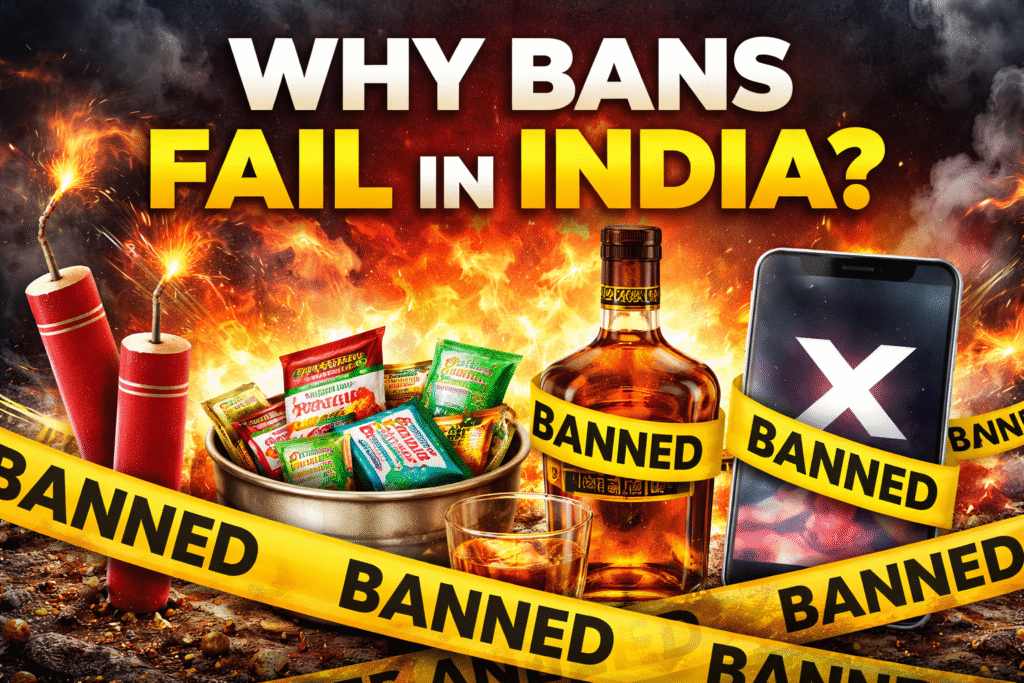
From Porn to Gutka: Why Bans in India Often Make Headlines but Change Little
India has a long history of bans. From gutka and alcohol to firecrackers, plastic, and now adult content on digital platforms, bans are often announced with urgency and moral clarity. Yet, months or even years later, the banned products and behaviours continue to exist—sometimes openly, sometimes quietly. This raises a critical question: Are bans in India about solving problems, or about being seen as solving them?
The recent action involving adult content moderation on X has once again brought this debate to the forefront.
The Indian Ban Playbook: A Familiar Cycle
Most bans in India follow a predictable pattern:
- A social, health, or moral concern gains attention
- Authorities announce a ban
- Headlines explode for a few days
- Enforcement weakens over time
- The banned activity resurfaces in new forms
This pattern has repeated itself across sectors.
- Gutka bans exist in most Indian states, yet informal sale networks thrive. According to public health estimates, smokeless tobacco still contributes to nearly 30% of oral cancer cases in India.
- Firecracker restrictions, especially during pollution emergencies, are imposed annually. Still, air quality data consistently shows post-festival pollution spikes in major cities.
- Alcohol bans in select states reduced official sales but led to the growth of unregulated supply chains, sometimes increasing health risks rather than reducing them.
Each ban addresses the symptom—but rarely the system that enables the behaviour.
Read more : Aerospace Engineering India
Digital Content Bans: Faster, Louder, Not Necessarily Better
Online bans appear more decisive because they are instant. Accounts are blocked, content is removed, and platforms issue statements about safety and compliance. But the digital world works differently from physical markets.
When one account is removed:
- New accounts appear within hours
- Content shifts to private groups or alternate platforms
- Users bypass restrictions using basic tools
Global digital policy studies suggest that content bans alone reduce harmful exposure by less than 25% unless paired with education, reporting systems, and long-term monitoring. In other words, moderation without strategy creates an illusion of control.
Why Bans Feel Effective—Even When They Are Not
Bans offer three political and social advantages:
- They are quick to announce
- They signal moral positioning
- They shift responsibility away from deeper reform
However, real change is slower and less visible. It requires investment in awareness, enforcement manpower, digital literacy, rehabilitation systems, and accountability mechanisms. These are harder to communicate in a press release.
As a result, bans often become performative tools, not transformative solutions.
The Core Problem: Behaviour vs Access
Most bans focus on access, while the real issue lies in behaviour.
- Gutka consumption continues due to addiction and lack of cessation support
- Firecracker use persists due to cultural habits and social pressure
- Harmful online content circulates because of demand, anonymity, and low digital awareness
Unless bans are paired with behaviour-change policies, the outcome remains the same: displacement, not elimination.
What Actually Works Better Than Blanket Bans
Evidence from public policy and digital governance points to more effective alternatives:
- Stronger enforcement instead of symbolic restrictions
- Clear accountability for platforms and sellers
- Public education campaigns with measurable outcomes
- Economic and social alternatives for those affected by bans
- Transparent reporting on what bans actually achieve
Countries that combine regulation with education and enforcement see significantly better results than those relying on bans alone.
Why This Debate Matters Right Now – From Porn to Gutka
India is at a critical stage where digital access, consumer behaviour, and governance intersect. Decisions taken today—especially around online regulation—will shape how future policies are enforced, challenged, or ignored.
Understanding why bans fail is not about opposing regulation. It is about demanding smarter regulation.
Final Thought – From Porn to Gutka
Bans make noise. Systems create change.
If India continues to rely on bans without fixing enforcement, awareness, and accountability, the outcome will remain predictable. The challenge is not whether to ban—but whether we are willing to do the harder work that makes bans unnecessary
- asia cup ind vs sl మహిళల ఆసియా కప్ ఫైనల్లో భారత్–శ్రీలంక పోరు, షఫాలీ వర్మ బ్యాటింగ్, దీప్తి శర్మ బౌలింగ్, భారత ఫీల్డింగ్ లోపాలు, ఇరు జట్ల బలాబలాలపై పూర్తి విశ్లేషణ
- US-Iran Talks at Lake Lucerne Show Major Progress: Nuclear Deal, Sanctions Relief, and Strait of Hormuz Security
- Modi Norway Visit 2026: India-Norway Green Partnership, Nordic Summit, and Press Freedom Debate
- Wipro Walk-in Drive for Service Desk Administrator in Bangalore | Freshers & Experienced Can Apply
- Peddi First Look: Shiva Rajkumar Stuns as Fierce Gournaidu Amid Telangana Exhibitor Standoff