
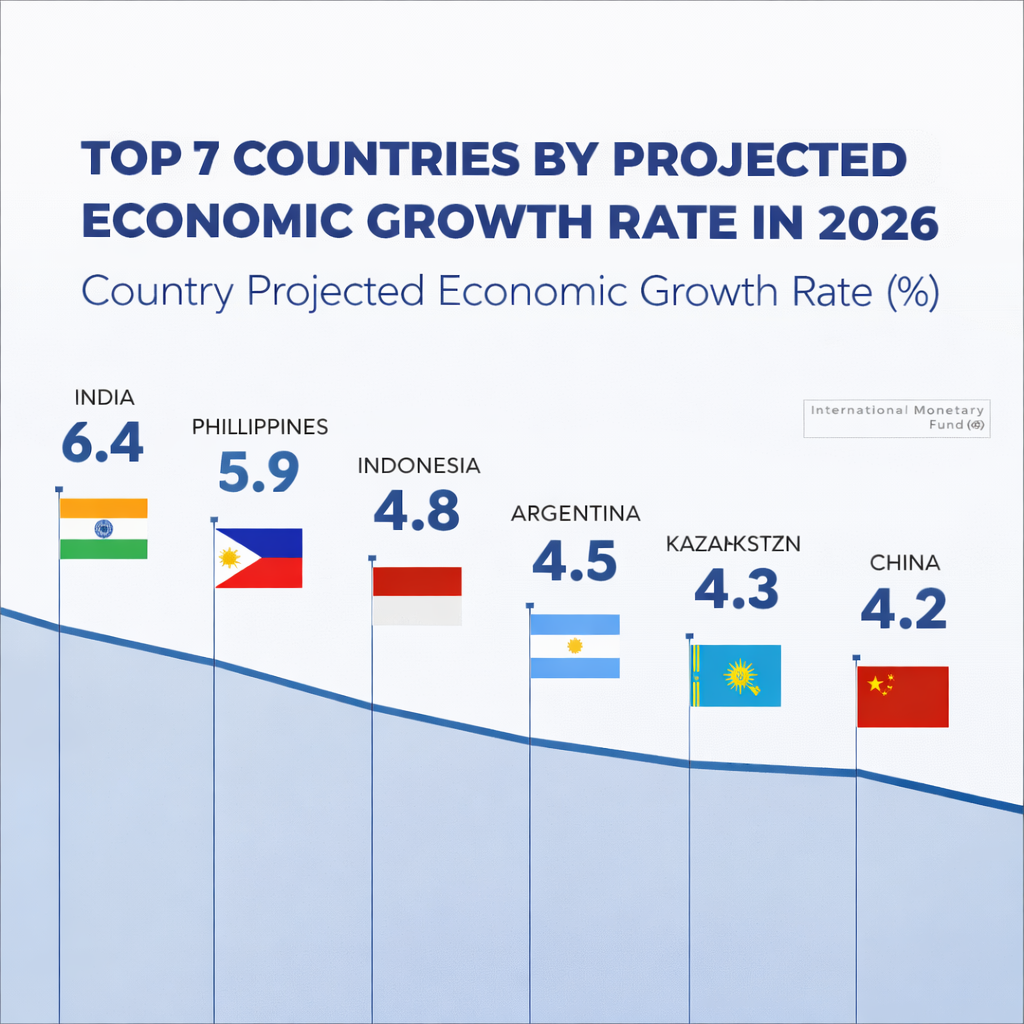
IMF Global Growth 2026 outlook highlights China and India as engines of the world economy
The IMF Global Growth 2026 outlook shows that China and India will together power nearly half of the world’s economic expansion next year, underlining Asia’s growing dominance in the global economy. According to the International Monetary Fund’s latest projections released on January 19, 2026, global GDP growth is expected to remain steady at 3.3%, but what stands out is the massive contribution coming from just two countries — China and India, which together account for 44% of total global growth.
China is projected to contribute 26.6% with a growth rate of 4.5%, while India will add 17% with a stronger 6.4% growth rate. Combined, their contribution nearly matches the rest of the world put together. This shift clearly signals how emerging Asian economies are reshaping the global financial landscape.
Why China remains a key growth powerhouse
China’s steady recovery supports global demand
Despite property market stress and global trade tensions in recent years, China continues to demonstrate resilience. The IMF expects the country to grow at 4.5%, backed by:
- Strong manufacturing output
- Rising exports
- Government stimulus measures
- Expanding tech and green energy sectors
China’s role as the “factory of the world” means its growth directly impacts supply chains, commodities, and international trade. Even moderate growth in China translates into massive global influence due to its huge economic base.
Infrastructure and innovation driving momentum
Massive infrastructure projects, electric vehicle production, semiconductor investments, and AI adoption are helping China maintain its competitive edge. These investments are not only supporting domestic employment but also boosting worldwide trade activity.
India emerges as the fastest-growing major economy
India’s 6.4% growth steals the spotlight
India is projected to grow faster than any other major economy at 6.4%, making it one of the brightest spots in the IMF Global Growth 2026 forecast. The country’s rising contribution of 17% reflects:
- Rapid digital transformation
- Startup ecosystem expansion
- Growing middle class consumption
- Strong services and IT exports
- Government infrastructure spending
For a country with over 1.4 billion people, even small improvements in productivity result in enormous economic gains.
Demographics work in India’s favor
Unlike many Western economies facing aging populations, India has a young workforce. This demographic advantage ensures sustained consumption, innovation, and labor availability — key ingredients for long-term growth.
From tech hubs in Bengaluru to financial centers in Mumbai and Hyderabad, India’s economy is diversifying faster than ever.
How the rest of the world compares
United States growth slows
The United States, still the world’s largest economy, is expected to contribute 9.9% of global growth with a 2.4% growth rate. While stable, this is significantly lower than Asian growth levels.
Factors affecting the U.S. include:
- Higher interest rates
- Slower consumer spending
- Inflation concerns
- Geopolitical uncertainties
Asia-Pacific dominates the global share
The IMF notes that the Asia-Pacific region contributes nearly half of the total global growth, showing a clear shift of economic power eastward. Emerging economies like Indonesia, Vietnam, and the Philippines are also adding momentum to regional expansion.
Global reactions to the IMF forecast
India celebrates rising status
Social media in India exploded with pride after the report. Memes, business discussions, and policy debates highlighted the country’s “second place” global contribution. Many see this as proof that India is becoming a serious economic superpower.
Nigeria gains attention
Nigeria also drew attention for ranking among top contributors, sparking optimism across Africa about the continent’s economic potential.
Western concerns grow
Meanwhile, several Western analysts expressed concern that slower growth in Europe and North America could reduce their influence in global trade and finance.
What this means for the global economy
Key takeaways from IMF Global Growth 2026
- Global growth steady at 3.3%
- China contributes 26.6%
- India contributes 17%
- Combined share 44% of world growth
- Asia-Pacific leads economic expansion
This trend suggests that businesses, investors, and governments will increasingly look toward Asia for opportunities. Supply chains, technology partnerships, and foreign investments are likely to concentrate more heavily in India and China.
Future outlook: Asia shaping tomorrow’s economy
The IMF Global Growth 2026 report makes one thing clear — the center of gravity in the global economy is shifting. China provides scale and manufacturing strength, while India delivers speed and demographic energy. Together, they form a powerful growth engine that could define the next decade.
For entrepreneurs, investors, and policymakers, understanding these trends is critical. The opportunities are no longer limited to Western markets. The future of global growth is increasingly being written in Asia.
As 2026 approaches, all eyes will remain on how China and India sustain this momentum — because when these two economies move, the entire world feels the impact.
read more :https://viralvista91.com/gukesh-vs-yagiz-kaan-ergodmus-wijk-aan-zee/